Thursday, July 27, 2006

Market Cooling: Is It Time to Buy?

It is still the American dream to own a home but with the market cooling and the Fed increase interest rates, is it really time to purchase a home? Amy Hoak of MarketWatch says in answer to this question:
Of course it is -- if you're buying it for a place to live, not as a speculative investment, and can afford to take the leap.
A cooling market is generally a buyer’s market. In a buyer’s market the number of houses available to purchase tends to be larger – the variety greater – asking prices diminish over time. Sellers tend to make more concessions than any other time. Sounds like a win win for buyers right?

Not so fast. There was an important point that bares a closer look. Can you afford to take the leap and if so how big of a leap can you take? If in doing the calculations you determine you can take the leap, then the next question to find the answer to is how much house can you afford? A house that meets your specific needs will also take into consideration the taxes on the property, the utility costs, and time to save for major repairs. Getting that combination correct may make difference in enjoying your new home and having to work hard to keep your new home.

The property tax records can shed some light on part of the answer. The seller can help with answers on utilities. Sellers willing answer these questions for prospective buyers. If you are working with a real estate professional they consider post sale budget in their research on properties to present to you – at least that is what I do. There is nothing worse than helping a buyer purchase a home only to have them have to turn around and sell it a few years later to prevent foreclosure.

A buyer’s market is a good time to buy, if you remember keeping the home five or six years is the goal.


Technorati: , , , , , , ,


For more information on Real Estate in New Jersey visit here.

To Disclose... or Not

During the home buying and selling process there comes a time when the seller must disclose facts about the property for sale. In New Jersey the Disclosure Statement is about six pages and gets signed but the seller, the buyer, and the agents involved. It asks question about the house from the roof to the soil surrounding the property and the neighborhood looking to get information on age, maintenance, and repair of big ticket items, any hazards on the property.

Understanding that houses have quirks the question becomes do I disclose quirky things or risk a lawsuit down the road for nondisclosure of material facts?
Ward Lowe recommends in his article: Hazardous Duty:
“It’s probably best to strive for full and complete disclosure rather than attempting to determine if a particular buyer would find the information important in deciding whether to buy the property.” New Jersey Realtor (July 2006)

Assuming a seller intends to fully disclose the condition of the property is a seller qualified to answer question on things like dry rot, wood destroying insect infestation, aluminum wiring, or underground storage tanks? If the home was built before 1978, it is fairly safe to assume at sometime the home had lead-based paint applied to it. Since 1992 the federal government requires that all sellers disclose the presence of lead-based paint. Disclosure of the presence of lead-based paint in houses built before 1978 makes sense even if the seller is unaware of exact locations.

Disclosure is designed to protect the seller by putting in writing exactly what the buyer can expect in his or her new home. Major repair surprises generally end up in court and could prove costly if the nondisclosure claim finds the seller culpable. Disclosure helps the buyer plan for the maintenance and upkeep of the home. It is much easier knowing one has to prepare for a new roof in ten years then it is to have no idea when the roof had attention. Full disclosure makes the buyer aware of just what he or she is getting for their investment dollars and leaves the seller unconcerned about future nondisclosure culpability.


Technorati: , , , , ,


For more information on Real Estate in New Jersey visit here.

Tuesday, July 25, 2006

Tip of the Day

Since January 2006, the Federal Housing Administration (FHA) has given home buyers and sellers a reason to reconsider FHA loans. In the past the FHA process tended to be slower and less flexible than conventional and even some non-prime loans. In an effort to help borrowers, who get stuck with hidden fees, penalties, higher mortgage insurance premiums and higher interest rates, and sellers who often ended up paying more of the closing costs with FHA borrowers, the FHA changed it requirement to ones similar to its competition. These changes make FHA loans expands the options available to both buyer and seller. Learn more.


Technorati: , , , , ,


For more information on Real Estate in New Jersey visit here.
Thursday, July 20, 2006

Fannie Mae and the Fed Speak

Real estate brokers have larger inventories than last year and it takes longer to match seller to buyer. Here it is from Fannie Mae economists David Berson and Molly Boesel:
"Total U.S. home sales will fall by eight to ten percent in 2006 as mortgage rates hit a five-year high…"

"Home price gains are expected to slow sharply this year, by 3.0%.
" MarketWatch: Robert Schroeder

What this means to the home seller is as I stated in Housing Market Recovers After Boom planning and timing are essential to meeting your goals. Whether you go FSBO or work with a real estate professional, getting a house sold takes a bit longer.

With the higher interest rates the amount of house buyers can afford in less. Mortgage loan interest rates are still on the rise and Fannie Mae a economist Berson and Boesel said “the central bank is likely to keep raising interest rates in the near term.” If the economists are correct then mortgage rates will continue to climb as well.

Federal Reserve Chief Ben Bernanke testified before Congress that inflation remains a concern and that the economy was likely to slow and that this should ease inflation pressures. It does not sound like we have seen the last of the rate hikes.

More ominous was his statement that the full impact of the past rate hikes has not yet hit the Nation’s economy. It makes the Berson and Boesel prediction sound credible. MarketWatch reports that applications for mortgages fell 4.6 percent last week which suggests that buyers are paying attention to interest rate news.

The real estate investor, particularly real estate investment trusts (REIT) seem a bright spot in the real estate industry. In a story by John Spence apartment REITs are expected to post the larger gains in a report due out next week.
Overall, we don't expect many surprises, but rather further confirmation that business is good with occupancy, rents and earnings on the rise," said Deutsche Bank analyst Lou Taylor.MarketWatch: John Spence
It remains to be seen what it all means for the single-family home market, mortgage rates, and real estate sales generally, in the near future.


Technorati: , , , , ,


For more information on Real Estate in New Jersey matters visit here.


Wednesday, July 19, 2006

It's All About FICO

When you are looking to purchase a home, the thing to do is get your credit report and look at your FICO score. Fair Issac and Company (FICO) developed a method of determining if persons will pay their bills. The Fair Issac and Company product is called a FICO score. The scoring system is widely accepted by lenders as a means of credit evaluation. The higher your score the less interest you will pay in a loan when your loan gets approved and other perks lenders have to offer.

A mortgage is a type of loan used to pay the difference between the down payment and the actual selling price of a property. There are two methods of finding a mortgage lender. The first method has you going to a mortgage banker and beginning the application process. If you are approved you will be ready to look for a house. This does not mean that you actually have the loan though; it just means the bank is satisfied with your credit enough to pre-approve you for a certain amount. Once you have signed an agreement to buy a house you will begin the application process in earnest. If you loan is approved, (meaning the underwriter has all the information needed for approval and the appraiser agrees with the price you intend to pay for the property and a host of other things) you go to closing. Otherwise you must find another mortgage banker and begin there process.

The second method has you working with a middleman known as a mortgage broker. The broker does the loan shopping for you. The advantage of the broker is he can look at lenders who do not deal directly with the public according to a story by William Bronchick. The broker has more experience in working with lenders and knows how to present your application in a manner that could aid in its approval.

Choosing the route you want to take to a mortgage depends on the amount of time you have to put in pre-approval applications. Remember pre-approval quotes are not binding to the lender. The application has a number of contingency clauses that must be met. The contingencies protect both the buyer and the lender. If your FICO score is 670 or better you will look pretty good to a lender. If your score is 600 or below lenders will have difficulty offering you a mortgage or your interest rate will be higher.

The following list shows the things in the credit history the FICO score analyzes:

  • Late payments
  • The amount of time credit has been established
  • The amount of credit used versus the amount of credit available
  • Length of time at present residence
  • Employment history
  • Negative credit information such as bankruptcies, charge-offs, collections, etc.
(Source)
Correcting the things that affect the credit history takes time but getting the job done can make the dream of homeownership a reality. Here is a link to a page that has a number of calculators available to assist you.


Technorati: , , , , ,


For more information on Real Estate matters in New Jersey visit here.

An Audio Response (My First)

Well I have had a bit of adventure thanks to the heat. The server went down and my post when to wherever lost posts go. Here is my remake.

I am trying out my first audio blog. I am still a babe in the woods when it comes to blogging so be kind. I am learning and having fun while I am doing it. That I am even attempting an audio response is a surprise in itself.

Now this audio is in response to a question from Professor Kim to my story on The New Starter Home Strategy. I am both pleased and honored that she found my attempt worthy of comment.

powered by ODEO


Technorati: , , , ,


For more information on Real Estate in New Jersey visit here.

Monday, July 17, 2006

The New “Starter Home” Strategy

In the past, people purchased a starter home to live in prior to settling down to raise a family. With fluctuating interest rates that plan is no longer feasible. Purchasing a home is much like any other purchase you make – you buy the best you can afford at the time. In housing, that may mean buying a larger house even though you do not expect to need a larger home until some future date. Buying a starter home with the expectation of upgrading at some future date is not a good strategy in the current market. To understand this bold statement, consider first interest rates.

Roper Public Affairs conducted a telephone survey of 1004 people and found “27 percent of homeowners think higher interest rates will make it difficult to make mortgage payments. It also reveals 24 percent currently carry an adjustable rate mortgage (ARM) or a specialized home loan—a figure that jumps to 37 percent for those aged 25-49”

It also found:

  • 23% of homeowners to consider refinancing

  • 61% of renters to have difficulty paying their rent

  • 78% of renters to have difficulty purchasing a residence in the near future”
(Broker Agent News)

Next if you think home equity will help you finance the upgrade home consider moving costs, closing costs, and real estate fees. These costs will take a big bite out of the starter home equity fund.

If you were counting on the salary increases to help finance that upgrade home Home Additions Plus reporter Mark J. Donovan say “home prices have far outpaced salary increases. Quite frankly that chasm seems to continue to grow.”

It seems people stay in the home they purchase when interest rates are higher. Now armed with the above information, you can adjust the long-term home buying plan to one more in keeping with today’s reality. Planning to purchase the starter home then upgrade at some future date will probably cost more today than in the past. Instead of planning an upgrade to that family home after the starter home, if interest rates are low, purchase the best family home you can afford. Consider all the things that you would when looking for a family home: schools, community, transportation, entertainments, playgrounds, parks, etc. in that first purchase even though the need has not yet materialized. Make your first home purchase with your future plans in mind then plan to remain in your “starter home” for twenty years. Plan to build twenty years of equity into this “starter home” before making another move that way the equity has a better chance of being an asset.


Find more information on real estate matters here.


Technorati: , , , ,


Thursday, July 13, 2006

Real Estate vs Stock

In an ideal world people have both kinds of investments in their portfolios – but our world is not ideal. Generally Americans do not view their homes as part of their investment portfolio. Traditionally people purchase homes to raise their families making their home their single long-term investment. Some homeowners invest in stocks for financial security or to see them beyond retirement. That is changing some, in part because of the downfall of companies like Enron and the fact that people are bombarded with volatility of the stock market daily: online, newspapers and television. Real estate investing appears more stable and many people are turning it away from stock.


In light of these misgivings, some investors may find direct investment in individual real estate projects an attractive alternative to pouring funds into equity shares of corporations, including real estate investment trusts (REIT), or even corporate bonds… Investors in real estate projects have the opportunity to take more direct control of their investments,” reports Charles E. Gilliland.


It would be easy to just encourage people to buy homes (after all I am a real estate professional) but real estate is only one type investment strategy and timing is an important issue. If you are willing to do some homework and have the time and inclination to deal with the tasks in owning real estate then it can be a lucrative business. If you find the volatility of the stock market distressing and want to have better control over your investments then real estate makes sense for you.


In a comparison of real estate vs stock Forbes.com’s Sara Clemence found that in the short term real estate is the better (1999-2004 stats) deal but looking at a term of say 25 years then the stock (S&P 500) is the winner. While it is true that in the long-term the stock market appears to do better, the comparison is not simple and some important numbers did not make the comparison as Ms Clemence freely admits. The dividends homeownership were not factored into the comparison such as rental income. Then again stocks do not have repair costs. The idea is to figure out what is the best way to make your money work. For some that will be real estate and for others it won’t.


Now don’t get me wrong, what I am talking about is not a substitute for professional financial planning advice. A financial planner helps individuals decide what is best for a particular situation. That said collecting the dividend of homeownership rather than giving it away in paying rent makes sense. Do you homework. Know what is happening with you portfolio and remember a home is part of your portfolio.


Technorati: , , , ,


Find more information on real estate matters here

Wednesday, July 12, 2006

Tip of the Day: Selling? Staging Effect Dollars

When selling a home, there is a relationship between the selling price and how buyer feels about the house – how the home showed. With the change in the market of last year, sellers have to “show off“ the attractions of a home to make is stand out from the other places a buyer sees. The home stager helps sellers make the transition from lived-in home to house for sale shortening the time a home spends on the market. To get top dollar for a home, sellers should seek the advice of a home stager.

Home stagers give aggressive advice to help people sell their homes. They may
suggest new paint colors, how to rearrange furniture, what to take off walls and
shelves. If needed, they’ll even loan or rent furniture and accessories to dress
up a place” reports
Annie Calovich of the Wichita Eagle.

What the seller must remember is buyers want to look at a home and imagine it being their home. If there are too many reminders (personal items, knickknacks, and pictures) that disturb the potential buyer’s imagining, the buyer will look elsewhere. Staging helps the seller remove all disturbing influences. Large furniture pieces may be comfortable but two many pieces become clutter and make a room appear smaller. Less furniture can also make a small room appear larger. The home stager can help the seller determine what will help the house sell.

According to Keith Rockmael, a contributor to The Christian Science Monitor:


Many people are under the misconception that staging is a pricey option for rich homeowners. Not true: Staging is about the creativity, not the money. What some people don't realize when they sell their house "as is" or don't stage is that it can actually cost them money.

Home staging need not be expensive if the homeowner is willing to help with the work of preparing a house for sale. A staging consultation can cost as little as $250. Some professional realtors take the extra training to become home stagers or have a list of home stagers they have worked with in the past and are willing to arrange a consultation.

Preparation of a home for sale is different from just living in the home. Clutter, often familiar and comfortable to the homeowner, can prevent a top dollar home sale. Having an expert help you take the steps to depersonalizing a home may well be worth the price of a consultation.


Technorati: , , , , , ,

Monday, July 10, 2006

Wake Up and Pay Attention


The Problem: Interest Rates are going up

The 30-year fixed mortgage interest rate increased nationally from 6.33% to 6.4% this week while the 5/1 adjustable rate mortgage also increased from 5.93% to 6.01%. In New Jersey, the numbers are a bit higher but the rate actually fell from 6.44% to 6.42%.

The federal fund rate increased slightly over the last three months. The federal fund rate (FFR), which is the interest rate banks with excess reserves at a federal-reserve district bank charges member banks needing overnight loans to meet reserve requirements, is the most sensitive indicator of interest rates because it is set daily by the market. It is more sensitive than the prime rate which is set by banks or the discount rate which is set by the Fed.

Why it Matters to You

The rate increasing means an average buyer will get less house for his or her investment dollar since more will go to repaying the interest on the mortgage. It makes sense to pay more during the early few years of the mortgage to pay down the principle so that the amount paid toward the end of the mortgage will decrease.


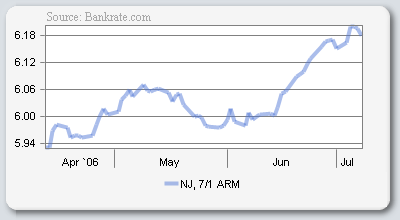
For those whose credit history is relatively small or those with poor credit the outlook is less promising. Often these buyers are ineligible for fix rate mortgages. The 7/1 adjustable rate mortgage (ARM) rate in New Jersey though lower than the 30-year fixed rate at 6.18% dropped from last week’s 6.2%.

Unfortunately, a 7/1 ARM means after the first seven years of the mortgage, the rate can change annually. Many people are finding themselves facing foreclosure with ARM payments becoming too high for their income. According to Foreclosure.com foreclosures are expected to rise across the country. An article appearing in the business section of Colorado's Pueblo Chieftain describes the situation of one family. The falling unemployment rate has helped keep more people from falling behind in the first three month of this year but it is a delicate balance. Any rise in the unemployment rate and the expected rise in the foreclosure rate may almost be a certainty.

What is Happening

Buyers are not the only one taking a second look at things. Builders are also re-evaluating their perspectives on the new-home market as are their investors. The sellers market of 2005 has changed. What the new-home market can tolerate is still unclear but builder confidence is decreasing according to the National Association of Home Builders/Wells Fargo Housing Market Index (HMI) for June. From a May report to the June report the index for the Northeast fell seven points.

What the rising interest rate means to the house seller is that it will take longer to find a buyer. If the house seller is using the sale of their present home to purchase their new home getting the timing synchronized will be essential. Pre-qualifying for mortgages will help determine the amount of house a buyer can afford. The best place to find a person with the most experience of pointing people in the right direction for a mortgage broker is the professional realtor. Still mortgage brokers are not hard to find.

What You Can Do

Everyone involved in the housing market is affected either directly or indirectly by the changes in the interest rate and everyone needs to pay attention. The housing market is directly impacted by the unemployment rate. So a rise in it will affect the housing market. Hopefully the American economy will stabilize and her people will remain employed. We all need to just keep an alert eye on things.


Technorati: , , , ,

Monday, June 26, 2006

Tip of the Day: Made for Snoozing

It is raining again here in the Garden State and while it is not as bad as some areas of the country, homeowers still have a few things to keep in mind. Most of the trees here have their full Summer foliage. When the sun shines it is not hard to pull out the hammock, grab that iced and snooze in the shade of a favorite tree. There are plenty older trees around who have served generations of hammock lovers but as trees age much like people they need checkup every now and againg to make sure they are aging well.

Recently I heard the tale of a tree limb that fell on power lines taking them down, snapping the light pole, and landing to lay across a road completely blocking the roadway. While it is unusual for a healthy tree to just fall over, excessive water can become a factor in the death of a tree. With rain falling on leaves many trees have trouble supporting the additional weight of water on so much of its foliage. Also when the ground becomes saturated, water-laden trees become candidates for potential disaster.

So before you pull out the hammock or even take that first sip of tea, it is important to make sure your snoozing buddy is healthy. Give dead or sick trees attention to prevent accidents. While trees at the curb are often cut by the city or township or utility company to train the tree to stay away from power lines, it is the homeowner's responsibility to make sure their trees do not pose a hazard. With a bit of care you and your snoozing buddy have many years of enjoyment.


Technorati: , , , ,


Thursday, June 22, 2006

Thinking of going FSBO? Ask these questions first.

Homeowners are often do-it-yourselfers, so it's not surprising that "For Sale By Owner," or FSBOs, has become popular. However, a homeowner who chooses the FSBO route over working with a realtor may have more troubles making a sale at the best price. Here are some things to consider to help you figure out whether it's in your best interest to work with a realtor or go FSBO:

1. How do you determine the right selling price for your house?
There's a big difference between the market value and the assessed value of a home. A realtor works anywhere from eight to twelve hours a day doing various tasks that give him or her, a good idea of how long it will take a property to sell. So in reality the do-it-yourself house seller is at a disadvantage but still there are many who will to take on the second job of preparing and selling their home. The factors involved in determining the market price of a home includes examining the price at which other similar houses in the area sold for, finding out how many other houses in the area are on the market and what they are selling for, deciding how much time one will can wait to move to your new home and more. The timing issue is an important concern because it cost more to insure and empty house and most people have to sell the old house in order to purchase the new one.

2. What's the real cost of working with a FSBO company?
Some FSBOs actually charge as much or more in fees than a broker would make in commissions! For example, I had one prospect explain that they were FSBOs but were willing to work with realtors. This prospect said they were giving realtors six percent commission and had paid a flat fee to their FSBO company. When I checked the listing what was going out to realtors was 2.5% to the transaction broker and 2.5% buyers' broker. There was one percent unaccounted for. I wondered if the FSBO company got a flat fee from her and an additional one percent commission. Also this particular prospect state she did not have a realtor helping them but one was one listed. If as a FSBO they were doing all the realtor work, why did they have a transaction broker listed and was he going to get a commission on the work they did? All of this is to say there are no short cuts and in the real estate business or in life, one gets what one pays for or works for.

3. What incentives are you willing to offer realtor to work with you if any?
Incentives, in this case, mean the commission you will pay realtors to bring buyers to your house. If you decide to work with realtors, you need to know what incentives are in your area and you need to know what percentage you have offered. Know exactly what you are paying for from your FSBO company and what services you will receive for your dollars.

4. What tools will the FSBO company make available to assist you with the sale of your home?
Learn to work with the tools realtors use to help make sure all the I's get dotted and the T's get crossed. One of the tools realtors use is the Pending Sales Index (PSI). The Pending Sale Index is based on the number of signed contracts in a giving area. There are other indicators but the PSI is a good indicator of how homes sales are going in any given month. Looking at the numbers for the month of April is a good way to determine what the market is doing and comparing that to pervious months or years – well you get the general idea. National Association of Realtors (NAR) said the index for April fell to 106.7 and was 9.3 percent below a year ago in the Northeast.

What this means timing is everything. The market is steady but houses take longer to sell. They are not bring the closing prices of a year ago either. There are exceptions but the trend is for the above. Determining the correct selling price is essential.


, , , ,

Tuesday, June 13, 2006

Tip of the Day: Homeowner Insurance Coverage Issue


Purchasing a new home? Did your old house sell on time … or not? Considering going ahead with the move into the new house? Did you know that when you move out of the old home it is no longer covered by your homeowner’s insurance? Most homeowner’s insurance plans cover the home as long as you live at that residence. Once you move out, though the coverage may be up-to-date your carrier will not pay out if something happens to or within the empty dwelling. If you leave the an empty house – whether because it did not sell or the timing did not work out quite right with the buyer – an empty house insurance coverage is not the same as an occupied house. In fact the cost is higher. Timing sale and purchase maneuvers to coincide just so, requires careful planning and attentiveness. Purchasing a supplemental insurance plan to cover the house during the transition period just makes sense.

Technorati: , , , ,

Friday, June 09, 2006

Housing Demand VS Historic Preservation Efforts

New Jersey has the highest population density in the United States at 1,134.4 per square mile according to the 2000 census. (Wikipedia) The land area of New Jersey is just 7,417 square miles so the demand for housing is high. Still New Jersey manages to manages to have about 20% of that area as working farmland which produce fruits, vegetables, and poultry. sea food and dairy products. There are laws that preserve both that Open Spaces and Historic Sites ensuring to that New Jersey will continue to be the Garden State.

At times the preservation efforts comes into direct conflict with the housing demand. New Jersey is uniquely situated because it is an easy commute to both New York and Philadelphia. The attraction in New Jersey is its rural lifestyles. One can get more “house” for investment dollars in New Jersey than in say New York City or Philadelphia. Some towns facing the demand vs preservation dilemmas find themselves re-examining their master plans to decrease the amount of open space which is the very thing that makes New Jersey attractive in the first place.

Preserving the history of towns for posterity is not only the job of each town council member but it is also the responsibility of every town member – or at least it should be. That some towns are knuckling under to the pressure of the short-sighted can only hurt in the long-run. A town’s need for operating capital is a consideration but parceling out open spaces for development would seem to exacerbate the problem by bring more people into an already distressed situation. It’s like when one has family over during the holidays. Everyone must adjust to the larger demand on the finite features of the home.

Since more young people purchase houses as safe investments, when they begin families, education funding will require augmentation. At present in some towns education budgets already have parents footing the bill for program services or watching extensive program cuts. Larger teacher-student ratios will eventual have the predicted effect on test scores so that those who can will look elsewhere when their children become school age. Where is the long-term gain then?

The Hightstown Planning Board faces just such a dilemma. According to a recent story in The Times of Trenton, the town council may have violated its master plan by allowing a large property in an area designated historic to be subdivided. While the matter will probably have to go to Superior Court now to settle the matter it seems best to stick with the well designed master plan and rather than make spontaneous changes.

Technorati: , , , ,

Thursday, June 08, 2006

Housing Market Recovers After Boom

In central New Jersey the market appears to be adjusting for last year’s sellers market where it was not uncommon to see 15 - 20% increases in property selling prices. The selling pace for 2006 is slower. Sellers must adjust their expectations to accommodate the longer time their home may spend in the Multiple Listing Service (MLS) before it actually sells. While buyers are looking for properties, the asking price and the selling price is generally less than similar properties that sold as recently as just December 2005.


"The real estate markets today across the country are very strong but there are pockets where we are beginning to see signs of trouble that are emerging," Federal Reserve Governor Susan Bies told a bankers group in Coronado, California. (Reuters)

The New Jersey market is steady. Area houses sell– just not as quickly as in 2005. The seller who wants to use the proceeds from the sale of one house to purchase another must compensate for the delay. It is a tricky maneuver to time the sale and purchase so that the funds become available at the time they are needed.

While many people purchased homes simply as a place to house families in the past, today’s buyer is looking for a safe place to invest their money. (Realtor.org Magazine) Housing is still a good investment and has raised the general wealth of Americans in the first quarter of 2006. (Reuters) With the increases in the interest rates over the past two years the housing market is naturally the first area to show the effects. For example a buyer may qualify for a $200,000 loan with a lower interest rate but as the interest rate climbs the amount of house, i.e. the amount of loan the same buyer can afford with the higher interest rate is less. Both the buyer and the seller will have to adjust to the changes various factors have on the real estate market of 2006. Still the outlook is good.


Technorati: , , , ,

Friday, May 26, 2006

Tip of the Day:

Cheap + good + fast = Good Investing Practices

When it comes to selling investment properties, getting the best price is essential – just as with a primary residence. Properties generally appreciate over time, which is what makes them good investments. However, maintenance is the key. Keeping the investment property in good condition makes for appreciating value and less hassle (making repairs found during inspection, negoitating with the buyer for repair costs, etc....) when the time comes to sell and invest the capital elsewhere.

Technorati: , , , , ,

Tuesday, May 23, 2006

It is a Vicious Cycle

Katrina (8/29/2005)

Courtesy of NOAA Evironmental Visualization Program


While hurricanes and other natural disasters decimate communities, fear of such disasters is also having a negative effect. According to Stephanie Singer, insurance companies are increasingly refusing to offer homeowners insurance to people in high risk areas. Without insurance there can be no mortgage so housing areas become further depressed and redevelopment efforts slowed.

In the article for Realtor.org Singer reports,

Admiral Loy stated “Fifty-seven percent of the American public lives in areas prone to natural disasters,” he said. “Hurricanes don’t just hit the Gulf states; in the past 100 years, 11 hurricanes have hit New England, and six have made landfall on Long Island.”

Since 2000 there have been 19 Billion-Dollar disasters on the continental United States according to the National Climatic Data Center. The list is pretty varied from drought, wildfires, flooding, hurricanes, and tornadoes. Most communities have difficulty recovering from billion-dollar disasters without homeowner insurance and even then government assistance may still be required.

With the hurricane season beginning next week, Atlantic City and Cape May are the most well-known areas in New Jersey that suffered from the effects of hurricanes travelling up the Atlantic Ocean; however, New Jersey has many smaller shoreline communities that have suffered hurricane effects. Though the coastal region is generally the area most affected by wind, rain, and surging sea, often inland areas can have problems with wind damage and flooding.

As the number of multi-billion dollar disasters rise, the need for swift and substantial federal assistance to the affected regions seems common sense. The need to spread the recovery costs over the entire country rather than expecting disaster affected areas to bear the weight alone is what one would expect from united states in theory, but whether that is what will actually happen is unclear. With Louisiana, Mississippi, Alabama, and Missouri clean-ups and recoveries after Katrina as litmus test areas one must wait and see.

Technorati: , , , ,

The Real Estate Professional Will Survive

I surfed the web and found my way to a website called BlogHer. It is a multi-author site that looks interesting. Anyway here's a link to my comments on the question of whether real estate professionals will become extinct.
Will Real Estate Agents go Six Feet Under?

Technorati: , , ,

Tuesday, May 16, 2006

New to Blogging

To say I am new to blogging is an understatement though I have some experience writing. The purpose of my blog is to discuss some of the things I see in the New Jersey housing market, offer some tips to homeowners, sellers, buyers and investers. I also want to put out there topics for discussion and to that end I will just jump right in with my first Tip of the Day.

With the rainfall in the Eastern part of the country expected to reach record highs central New Jersey has had a wet few days. The good of that for housing sales is that if there are any problems with water on the roof or in the basement both buyer and seller have a better opportunity to become aware of the problem. Repairs while primarily the responsibility of the seller the buyer may take on the task with some break offered in the asking price.

The bad of the rain is that more people want to stay-in and dry rather than risk getting wet. Rainy day showings means extra work in keeping the entryway dry, easily accomplished with an old bathroom rug.

Technorati: , , , ,